Water Heater Expansion Tank Installation in Rancho Cordova, CA
Water expands when it heats up. In an open plumbing system that's no problem — the excess volume pushes back into the supply main. But Rancho Cordova homes with a pressure-reducing valve at the meter have a closed system. There's nowhere for that expanded water to go. Pressure climbs every time your water heater fires, stressing the tank welds, the valves, the T&P relief, and the fittings every single heating cycle.
- Same-day appointments available
- Installed to California code
- Upfront, itemized estimates
- Clean work area & haul-away
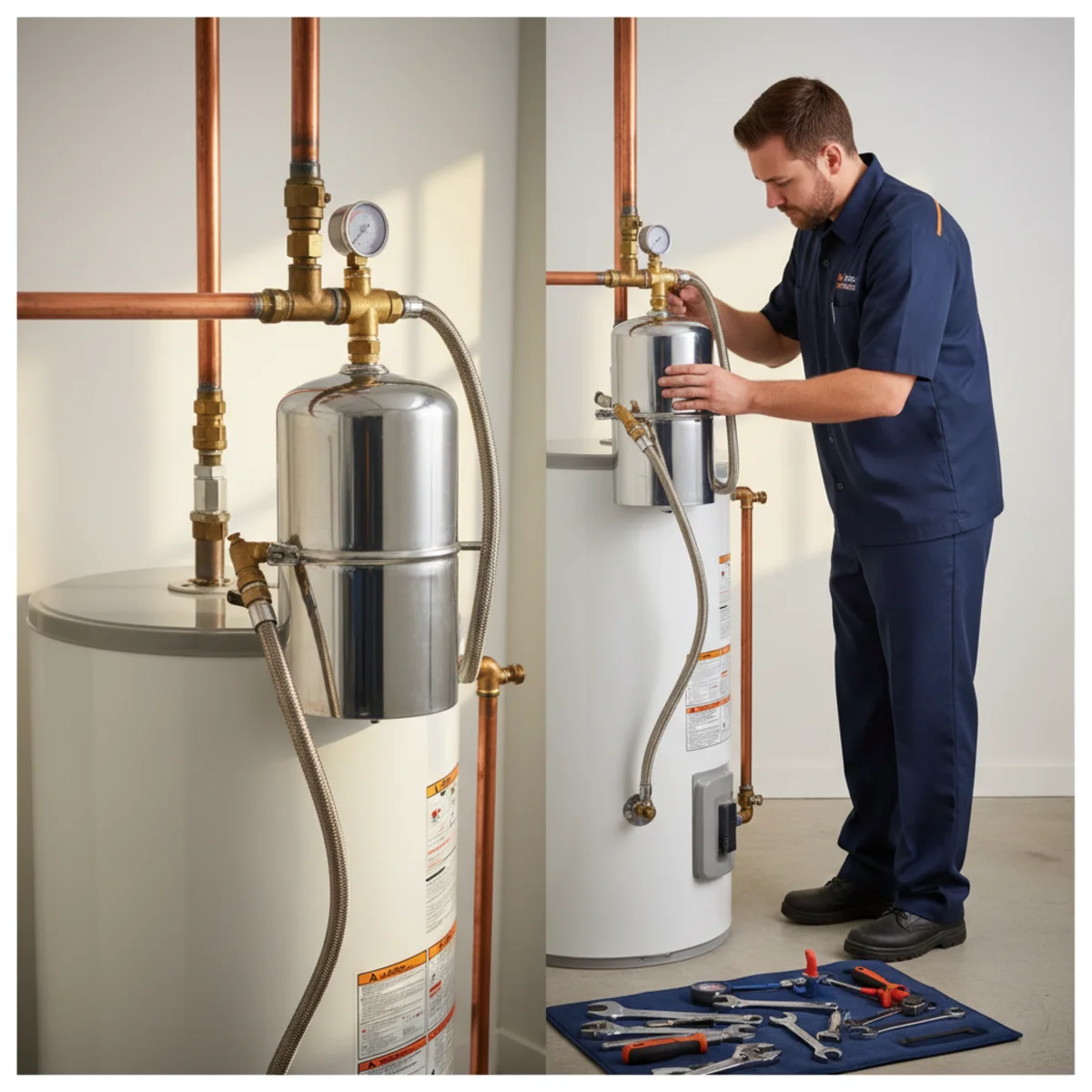
Water expands when it heats up. In an open plumbing system that's no problem — the excess volume pushes back into the supply main. But Rancho Cordova homes with a pressure-reducing valve at the meter have a closed system. There's nowhere for that expanded water to go. Pressure climbs every time your water heater fires, stressing the tank welds, the valves, the T&P relief, and the fittings every single heating cycle.
Before the expansion tank requirement became standard, you'd see T&P valves dripping regularly — that valve was doing its job, relieving over-pressure the system was never designed to absorb. An expansion tank (also called a thermal expansion tank or thermal expansion vessel) gives that pressure a cushion to push into instead. It's a small pressurized tank, pre-charged with air or nitrogen, mounted on the cold-supply inlet of your water heater.
California code now requires an expansion tank on closed systems, and Sacramento County inspectors check for it on permitted jobs. If you're having a new water heater installed or you're sorting out a permit and code upgrade, an expansion tank is almost certainly on the list. Confirm current requirements before you buy.
Quick Answer
An expansion tank absorbs the pressure that builds when water heats in a closed plumbing system — protecting your water heater, valves, and fittings from repeated stress. California code requires one on closed systems, and Sacramento County inspects for it on permitted installs. We size, pre-charge, and install expansion tanks correctly, with upfront estimates and same-day appointments often available. Call (201) 277-9344.
When to call
Signs You Need Water Heater Expansion Tank Installation
Not sure if it's time? These are the situations where water heater expansion tank installation in Rancho Cordova makes sense.
- Your T&P relief valve drips periodically, especially after a heating cycle.
- Your plumbing makes a ticking or creaking sound as the water heater heats.
- Water pressure at fixtures spikes and then drops — a sign of thermal expansion cycling.
- You have a pressure-reducing valve (PRV) at the main and no expansion tank on the water heater.
- An inspection or plumber flagged the missing expansion tank as a code deficiency.
- You're replacing your water heater and want to bring the system up to current code.
- Your water heater is wearing out faster than expected, and pressure stress may be a factor.
What's included
What Our Water Heater Expansion Tank Installation Service Covers
Closed-system confirmation
We verify whether your system is closed — checking for a PRV or other backflow preventer — before sizing the expansion tank. Not every home needs one, but most with a PRV do.
Correct sizing
Expansion tanks are sized by system volume and incoming pressure. An undersized tank hits its full charge quickly; an oversized one wastes money. We calculate the right size for your setup.
Pre-charge verification
The air pre-charge in the expansion tank must match your cold-supply pressure. We check and set the pre-charge before installation so the tank works correctly from day one.
Code-compliant installation
Mounted on the cold-water inlet, supported properly, and installed with appropriate fittings — the way Sacramento County inspectors expect to see it.
Pressure and T&P check
After installation we verify system pressure at rest and check that the T&P valve is no longer relieving under normal operating conditions.
Why it's done right
Why Proper Water Heater Expansion Tank Installation Matters
Safety
A T&P valve that relieves repeatedly is doing so because the system pressure is too high. That's wear on a safety device that has to work perfectly in a real overpressure event. An expansion tank takes that repeated stress load off the T&P valve and lets it remain in reserve for genuine emergencies.
Code compliance
California plumbing code requires an expansion tank on closed water-heater systems. An installation without one won't pass a Sacramento County inspection on a permitted job, and the gap can show up as a deficiency on a home inspection report during a sale. Confirm current code requirements before you start — details change.
Water-damage and equipment protection
Repeated thermal expansion pressure cycles stress the tank's glass lining, welds, and connections, accelerating corrosion and fatigue. They also beat on solenoid valves and cartridges elsewhere in the plumbing. An expansion tank absorbs those cycles quietly, extending the life of your water heater and protecting your plumbing fixtures.
Long-term performance
A correctly sized and pre-charged expansion tank requires almost no maintenance beyond a periodic pressure check — usually when you have your water heater serviced. It's a low-cost component that does a lot of quiet work over the full life of your system.
How we work
Our Water Heater Expansion Tank Installation Process
System assessment
We identify whether your system is closed, measure incoming water pressure, and check the current state of your T&P valve and water heater connections.
Size and pre-charge calculation
Using your tank volume, system pressure, and water heater capacity, we determine the correct expansion tank size and air pre-charge pressure.
Upfront estimate
We quote the expansion tank, fittings, and labor clearly — no hidden code-upgrade fees added after the job starts.
Pre-charge setup
We verify or set the tank's air pre-charge before mounting — this step is often skipped and causes premature tank failure when it is.
Install and connect
The expansion tank goes on the cold-supply inlet, properly supported, with code-compliant fittings and orientation.
System pressure check
We re-verify static pressure and run the heater through a heating cycle to confirm the expansion tank is working and the T&P valve is no longer relieving.
Walkthrough
We explain where the expansion tank is, how to spot a failed diaphragm in the future (waterlogged tank), and when to schedule the next pressure check.
Transparent pricing
What Affects Your Water Heater Expansion Tank Installation Cost
We don't post fixed prices online because every home is different — but here's exactly what moves the number, so your estimate is never a mystery.
Tank size (capacity)
Expansion tank sizing depends on water heater capacity, supply pressure, and the pre-charge pressure needed to match your system. Larger or high-pressure systems need a bigger tank, which affects the material cost.
Location and pipe access
The tank mounts on the cold-water supply line near the heater. If that line is buried, in a tight spot, or behind drywall, access labor rises before the tank even goes in.
System pressure check and PRV condition
If your pressure-reducing valve (PRV) is old or out of range, installing an expansion tank without correcting the PRV leaves the system over-pressurized anyway. Addressing both at once is the efficient call.
T&P valve inspection
We check the temperature-and-pressure relief valve while we're there. A T&P that's been weeping from thermal expansion pressure may be worn and due for replacement — catch it now rather than after the expansion tank is in.
Permit requirements
Some jurisdictions require a permit for an expansion tank add-on when it's done as a standalone job. We can tell you what Sacramento County expects for your specific situation — confirm current requirements before scheduling.
Local know-how
Rancho Cordova Considerations
The local details competitors treat as an afterthought — and we don't.
Sacramento County water supply comes through municipal infrastructure that often runs at 70–80 psi before any PRV. Most Rancho Cordova homes have a PRV set to 60–65 psi to protect interior plumbing — and that PRV creates the closed system that requires an expansion tank under current California code. If you're not sure whether you have a PRV, look for a bell-shaped fitting near your main shutoff. Confirm current code requirements before you buy or start any work.
Hard water adds a secondary dimension here. Rancho Cordova's mineral-heavy supply accelerates scale buildup inside the tank, and a system already under repeated pressure stress corrodes faster. Pairing an expansion tank installation with a water heater replacement — or even with annual flushing — extends the benefit significantly. We often discuss a drain pan installation at the same visit, since it's a short additional install and addresses the other big code checkpoint at once.
Expansion tanks have a diaphragm inside that can fail over time — when it does, the tank fills with water instead of air, and the T&P valve starts dripping again. The tank itself should last 5–10 years with correct sizing and pre-charge; we check the pre-charge on any service visit. If your T&P valve starts relieving again after an expansion tank install, the tank diaphragm is the first thing to check. Call (201) 277-9344 and we'll diagnose it quickly.
Related Water Heater Services
Water Heater Installation
New tank or tankless, sized right and installed to California code — permits, code upgrades, and old-unit haul-away handled.
Learn moreWater Heater Permit & Code Upgrades
Permit guidance and every required code upgrade — expansion tank, seismic strapping, drain pan, and proper T&P discharge — installed to Sacramento County standards.
Learn moreWater Heater Drain Pan Installation
Stop a slow leak from becoming a water-damage claim — drain pan and routed drain line installed where code requires it and where common sense demands it.
Learn moreWater Heater Replacement
Swap an aging or failed tank before the next leak — new unit sized right, installed to California code, old unit hauled away.
Learn moreAreas We Serve for Water Heater Expansion Tank Installation
Questions, answered
Water Heater Expansion Tank Installation FAQs
The clearest sign is a T&P valve that drips periodically — usually after a heating cycle. The underlying cause is almost always a closed system with no expansion relief. If you have a pressure-reducing valve at your main shutoff, you almost certainly have a closed system. We can confirm during any service visit.
On the cold-water inlet line to the water heater, usually within a few feet of the tank. It hangs vertically or horizontally depending on the mounting space available — orientation can affect the diaphragm's longevity, so we install it correctly for your setup.
Sizing depends on your water heater capacity and your system's cold-water pressure. A 2-gallon tank suits many standard residential setups; larger tanks or higher pressures may call for a 4.4-gallon or larger unit. We calculate it for your specific system.
The pre-charge pressure should be checked every year or two and after any significant change to your water pressure. A waterlogged tank — one where the diaphragm has failed — needs to be replaced. It's a quick check we can do on any routine service visit.
The plumbing connection is straightforward, but the pre-charge pressure must be set to match your cold-supply pressure before the tank is installed and filled. Getting that wrong defeats the purpose of the tank. It's worth having an experienced technician do it correctly the first time.
Not noticeably. It buffers pressure spikes during heating cycles but doesn't reduce static pressure. If your pressure feels low in general, that's a separate issue — possibly the PRV setting or a restriction in the supply line.
The cost depends on the tank size, the complexity of your cold-inlet plumbing, and whether any fittings need to be changed. We give an upfront, itemized estimate before we start. Call (201) 277-9344 for a free quote.
Helpful Water Heater Guides
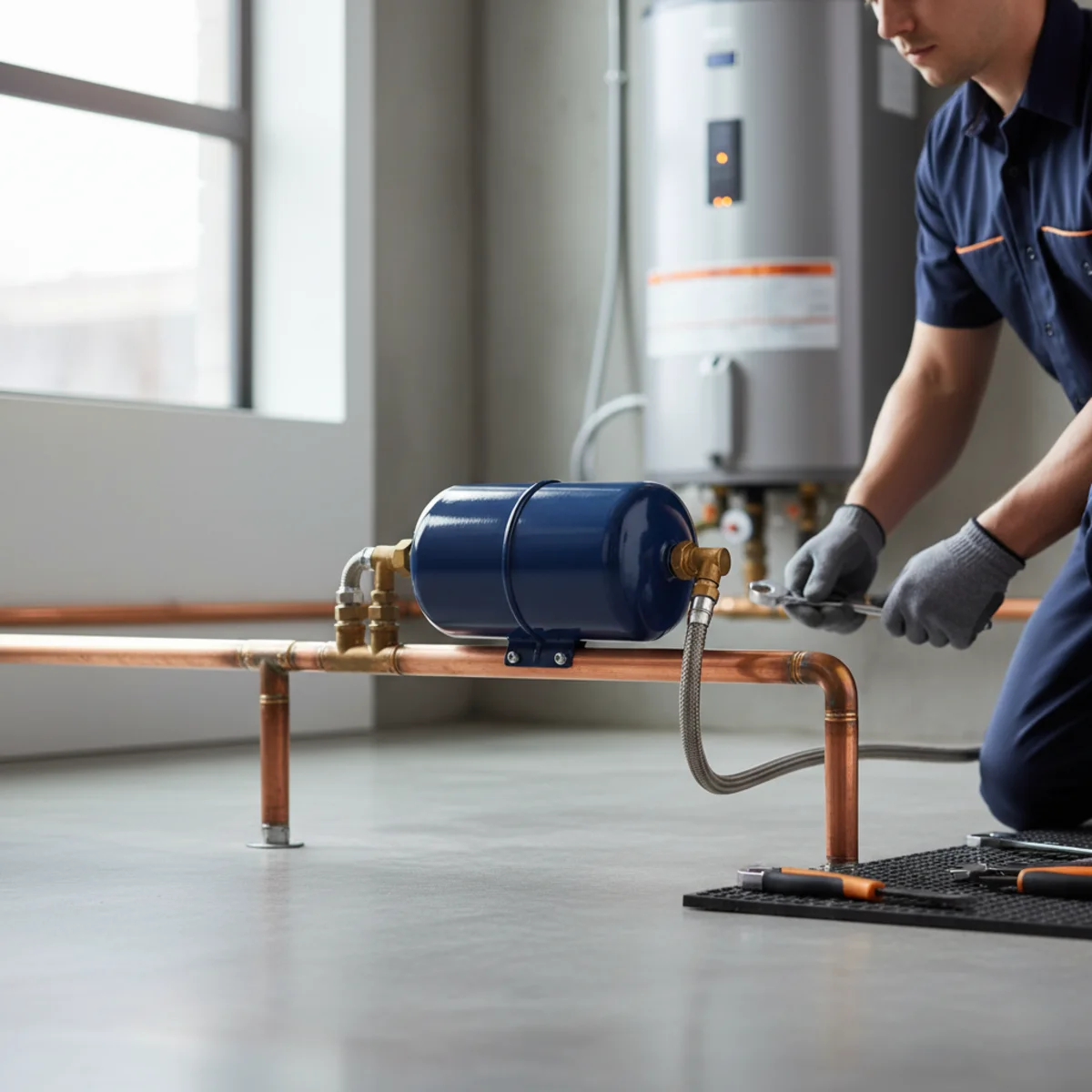
What Is a Water Heater Expansion Tank and Do You Need One?
If you're on a closed plumbing system, your water heater is building pressure every time it heats water. An expansion tank gives that pressure somewhere to go — and California code requires one in many cases.
November 24, 2025
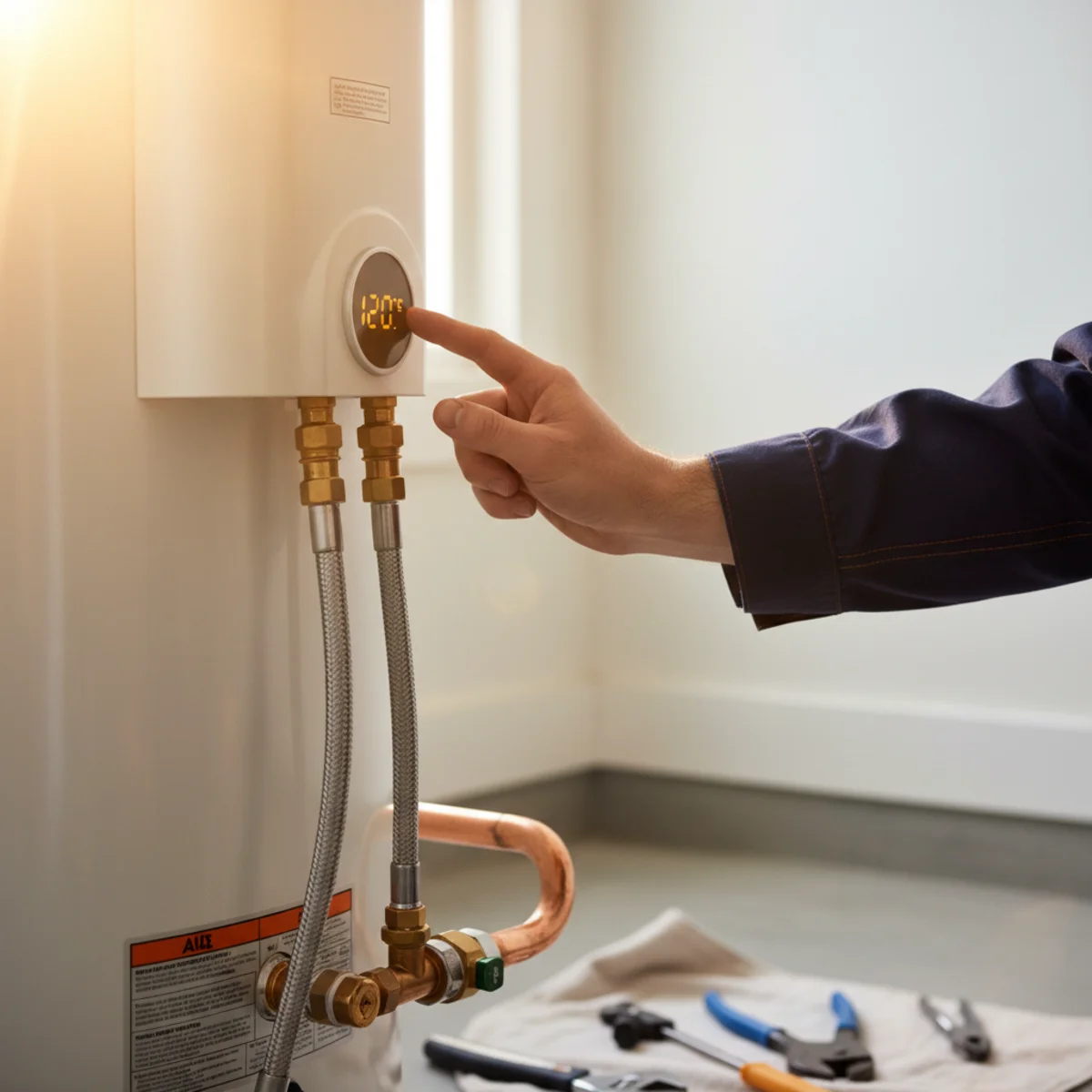
What Temperature Should Your Water Heater Be Set To?
The right water heater temperature isn't one-size-fits-all. Here's how to balance scalding risk, Legionella prevention, and energy savings for your household.
May 1, 2026
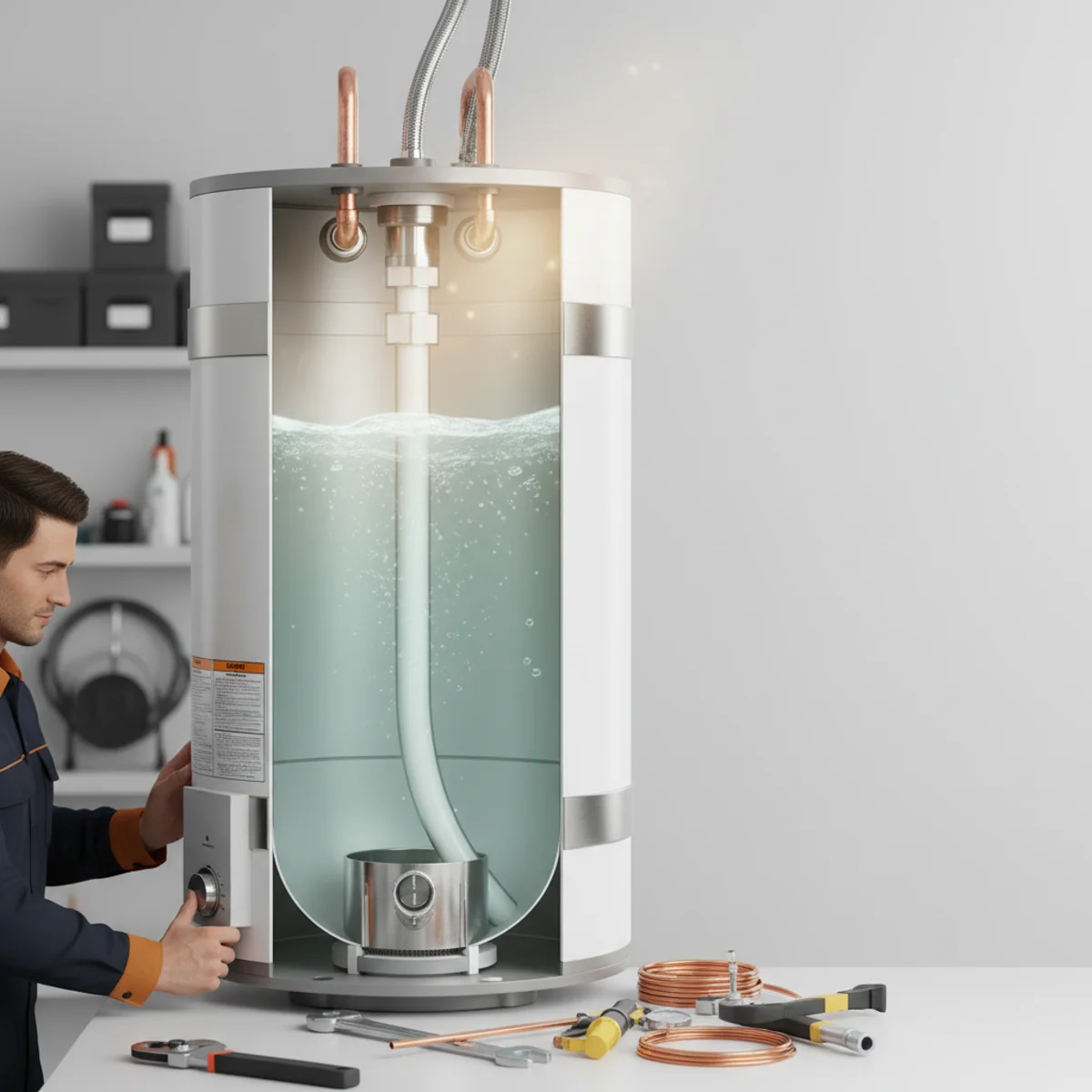
Lukewarm Water? Your Dip Tube Might Be Failing
If your water heater seems fine but showers go lukewarm fast, a failing dip tube is the overlooked culprit most homeowners never check. Here's what it is and what to do.
April 18, 2026
Our Standards on Every Job
- Installed to current California Plumbing Code
- Sacramento County permit guidance on every job
- Upfront, written estimates — no surprises
- Code upgrades included: expansion tank, seismic strapping, drain pan, T&P discharge
- Warranty-backed equipment options
- Clean, protected work areas and old-unit haul-away
Licensing and insurance information available on request. Programs and code requirements change — we confirm current details before you buy.
Local & Official Resources
Helpful third-party references for Rancho Cordova and Sacramento County homeowners. Programs and code change — confirm current details on the official sites before you buy.
- Sacramento County Building Permits & InspectionPermits, inspections, and code for water heater work in the county.
- SMUD — Rebates & IncentivesThe local electric utility's heat-pump and efficiency rebate programs.
- PG&E — Rebates & EfficiencyGas and electric rebate programs serving parts of the area.
- California Energy Commission — Appliance StandardsState efficiency standards that affect new water heaters.
- U.S. DOE — Water Heating (Energy Saver)Independent guidance on types, sizing, and efficiency.
- California Building Standards CommissionThe California Plumbing Code is part of Title 24.
Schedule Water Heater Expansion Tank Installation in Rancho Cordova
Talk to a local water heater pro who will give you a straight answer and an upfront estimate. For an active leak or no hot water, call now — same-day help is available.
3173 Fitzgerald Rd, Rancho Cordova, CA 95742
Have this ready for your estimate
- Know your current water pressure — a gauge on an outdoor hose bib works. If you don't have one, we'll check on arrival.
- Locate your pressure-reducing valve (PRV), if you have one, and note whether it's been adjusted or replaced recently.
- Confirm whether your system is "closed" — a PRV, backflow preventer, or check valve on the supply line is the usual indicator.
- Have your water heater's capacity in gallons handy; it goes into the expansion-tank sizing calculation.
- Clear the space around the cold-water supply line above the heater so we're not working around stored items.
Request a Free Estimate
Tell us what's going on — we'll follow up fast.
Same-Day Water Heater Help
Need Hot Water Back Today?
Same-day water heater help across Rancho Cordova and nearby Sacramento County. Talk to a local pro now — no pressure, just a straight answer.