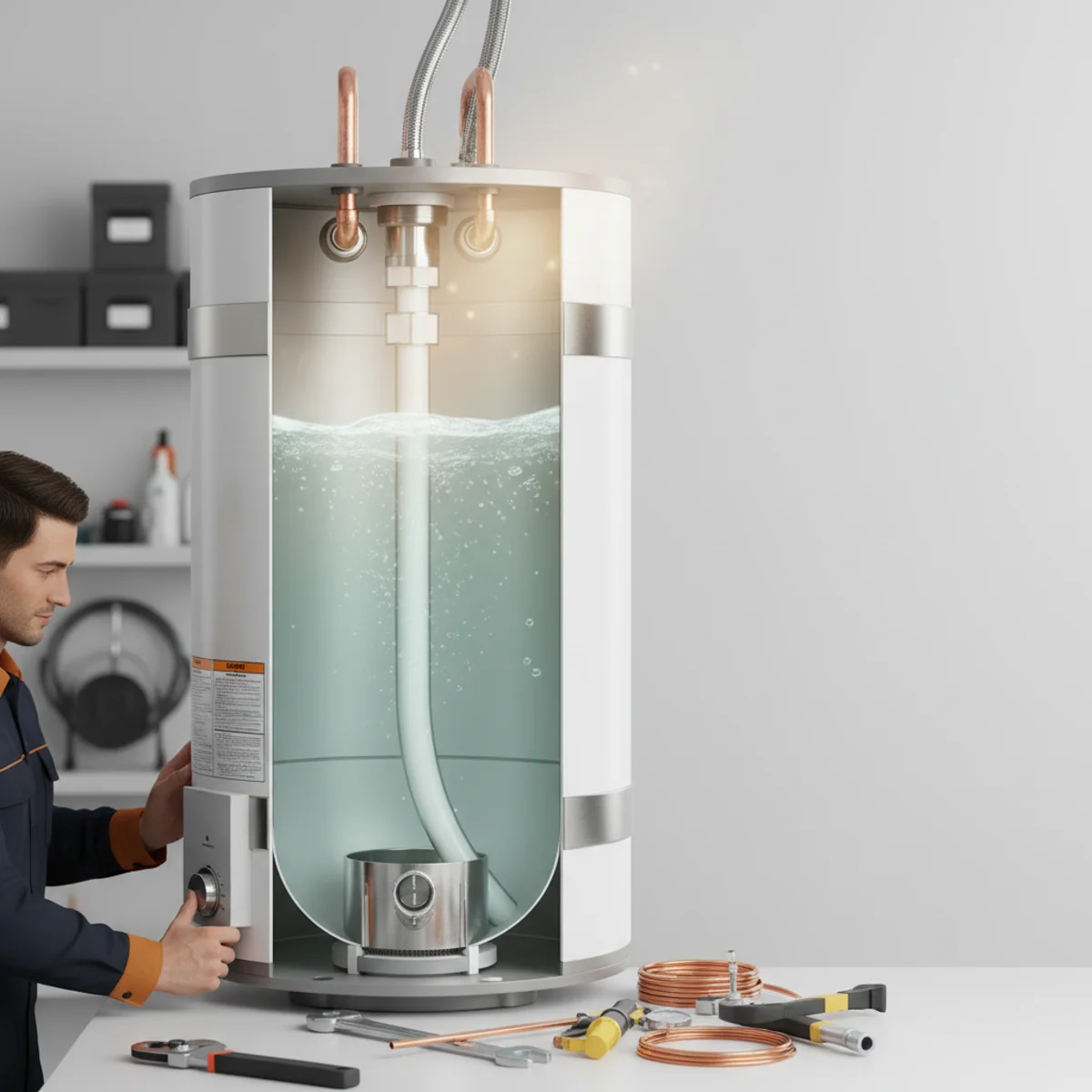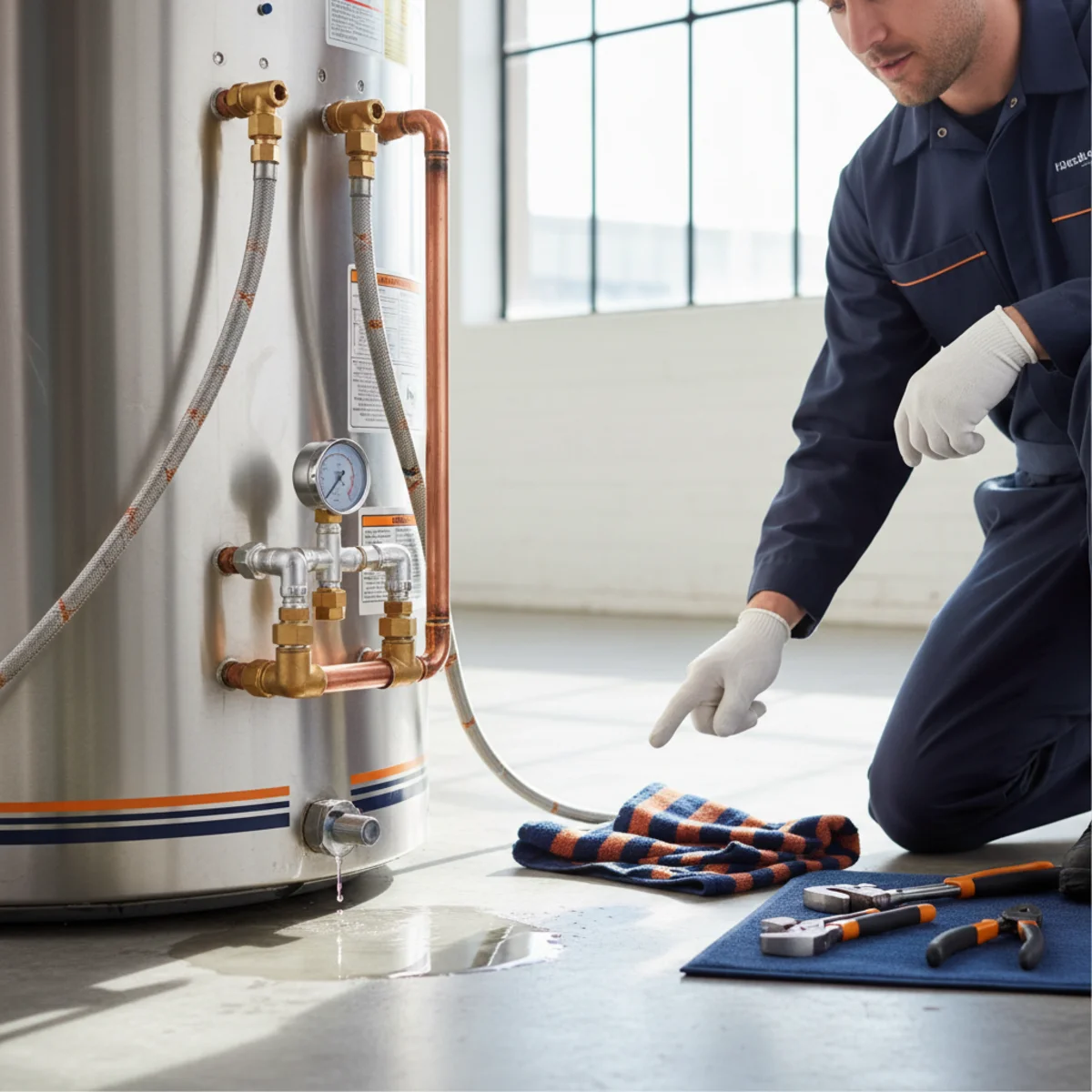
You walk into the garage and find a puddle at the base of the water heater. Your first instinct is probably right — this needs attention now. But "leaking from the bottom" can mean several different things, and the cause determines whether you're looking at a quick repair or a full replacement.
Not every bottom leak means the tank is done. Some bottom leaks trace back to the drain valve — a simple, inexpensive fix. Others come from the T&P (temperature and pressure relief) valve discharge pipe routed to floor level — potentially a safety issue but not necessarily a tank failure. And some bottom leaks are the tank itself, which means replacement.
This guide walks through each cause in order of urgency. Check yours against each scenario so you can give an accurate description when you call for service or decide what to do next.
First step: shut off the cold water supply
Before you diagnose anything, slow the leak. The cold water inlet valve is at the top of the tank — it's either a ball valve (quarter-turn) or a gate valve (multi-turn). Turn it off. This stops fresh water from entering the tank and reduces the leak rate while you figure out the source.
If you smell gas at any point, don't spend time diagnosing the water heater. Leave the house, don't flip any switches, and call the gas company from outside. A gas leak and a water leak at the same time is a separate emergency entirely.
Once the inlet is off, dry the floor around the base and let it sit for 10 minutes. Then look carefully at where new moisture is appearing — this isolates the source.
Cause 1: Drain valve drip
The drain valve is the hose-bib fitting near the bottom of the tank. It's used for flushing sediment and draining the unit. Over time, the rubber seat inside the valve degrades — especially on plastic drain valves, which are common on economy models.
A slow drip from this valve is usually fixable. Tighten the packing nut (the nut just behind the handle) first — sometimes that stops a minor weep. If it doesn't, the valve can be replaced without replacing the entire tank, provided the tank itself is in good condition.
This is the most optimistic diagnosis for a bottom leak. If the puddle is directly under the drain valve and the handle looks corroded or damaged, start here.
Cause 2: T&P valve discharge
The T&P (temperature and pressure relief) valve is a safety device on the side of the tank. It has a discharge pipe that California code requires to run to within 6 inches of the floor or terminate at an approved drain location. If the T&P opens — because the tank temperature or pressure exceeds safe limits — water runs out the bottom of that discharge pipe.
Finding water at the bottom near the discharge pipe terminus isn't the same as a tank leak. But a T&P valve that's opening repeatedly is telling you something: the tank is running too hot, there's a thermal expansion problem, or the valve itself has a failed seat and is weeping when it shouldn't be.
Don't cap or plug a T&P discharge. That valve is there for a reason. If you're seeing repeated T&P discharge, the underlying cause — overtemperature or excess pressure — needs to be addressed. An expansion tank may be missing or sized wrong, or the thermostat may be set too high.
Our leaking water heater repair team can diagnose whether the T&P discharge is a valve failure or a system pressure problem.
Cause 3: Internal tank corrosion and seam failure
This is the outcome no homeowner wants to hear, but it's important to recognize it quickly. When the steel tank lining corrodes through — usually at the bottom seam where sediment sits — the tank begins to leak from within. No repair is practical for a corroded tank.
Signs pointing to internal tank failure: the leak is diffuse rather than traceable to a single fitting; the water has a rust or metallic smell; the puddle grows steadily rather than dripping from a specific point; rust streaks on the tank exterior near the base.
In Rancho Cordova's hard water, tanks that haven't been flushed regularly are especially vulnerable to this failure mode. Sediment on the tank floor holds moisture against the steel and accelerates corrosion from the bottom up.
If you suspect tank failure, the unit needs to come out. Our water heater replacement team serves Rancho Cordova and surrounding areas — we can typically get a new unit in same day or next day for standard configurations.
Cause 4: Condensation
This is the harmless scenario — and worth knowing about so you don't panic over a normal event.
During the initial heating of a new tank, or when a tank runs a long recovery cycle from very cold inlet water, condensation can form on the exterior and drip to the floor. This is most common in unconditioned garages in winter — a very common installation location in Rancho Cordova.
Condensation is typically light, forms on the exterior surface, and evaporates as the tank reaches operating temperature. If the moisture disappears once the tank is fully heated and doesn't return, it was condensation. If it persists, trace it to a source.
What to do right now
Once you've identified the likely cause, here's the decision tree. Drain valve drip: a repair call is reasonable if the tank is under 10 years old and otherwise in good shape. T&P discharge: call for an inspection — the underlying pressure or temperature issue needs diagnosis. Tank seam leak: replacement is the only fix; the longer you wait, the higher the flood risk.
No matter the cause, continuing to ignore a persistent puddle under your water heater is the wrong call. Water damage to drywall, subfloor, or framing adds up fast — especially in a garage-adjacent utility room.
Contact us and describe what you're seeing. We'll ask a few quick questions to assess urgency and get the right tech to you.
Talk to a Local Rancho Cordova Water Heater Pro
Whether you need a repair today or you're planning an upgrade, we'll give you a straight answer and an upfront estimate.
Frequently Asked Questions
Use caution. A small drain valve drip with a functional tank may be okay to use briefly while you arrange repair. But a tank seam leak or a T&P valve discharge situation should not be left running. Shut off the inlet and call for service rather than running the unit until it fails completely.
Drain valve replacement is typically a modest repair compared to tank replacement. The valve itself is inexpensive; the labor involves draining the tank, swapping the valve, and refilling. An installer can give you a specific number once they confirm the rest of the tank is in good condition and worth the repair.
Policies vary significantly. Sudden accidental discharge is often covered for the resulting water damage, but the water heater itself is typically excluded as a maintenance item. A slow leak that caused gradual damage may not be covered if the insurer determines it wasn't sudden. Review your policy and report the claim promptly if you have property damage.
Water leaking onto gas burner components or corrosion around the gas valve can create secondary hazards. If you smell gas near a leaking water heater, treat it as a gas emergency — exit, don't use switches, and call the gas company from outside.
Written by the Water Heater RC Pros team
Practical, local guidance from Rancho Cordova water-heater installers — written for homeowners and kept current with California code. Have a question about your unit? Call (201) 277-9344.