Tankless water heaters are genuinely low maintenance compared to tank units. There's no anode rod to replace, no significant sediment layer to flush, and no standing volume of water to keep hot. But 'low maintenance' doesn't mean 'no maintenance,' and in Rancho Cordova's moderately hard water, skipping annual descaling is the single most common cause of premature tankless failure.
Mineral scale builds up inside the heat exchanger — the coiled copper or stainless tubing where the water is heated — and acts as an insulating layer that reduces efficiency and flow. A heavily scaled heat exchanger can reduce hot water output by 25% or more, trigger error codes on the unit's display, and eventually cause the heat exchanger to crack from thermal stress. Most manufacturer warranties explicitly require annual maintenance in hard water areas.
This guide covers everything a homeowner needs to know about keeping a tankless water heater in good working order — what maintenance tasks exist, which ones are DIY-friendly, and which are best left to a professional.
How Mineral Scale Affects Tankless Performance
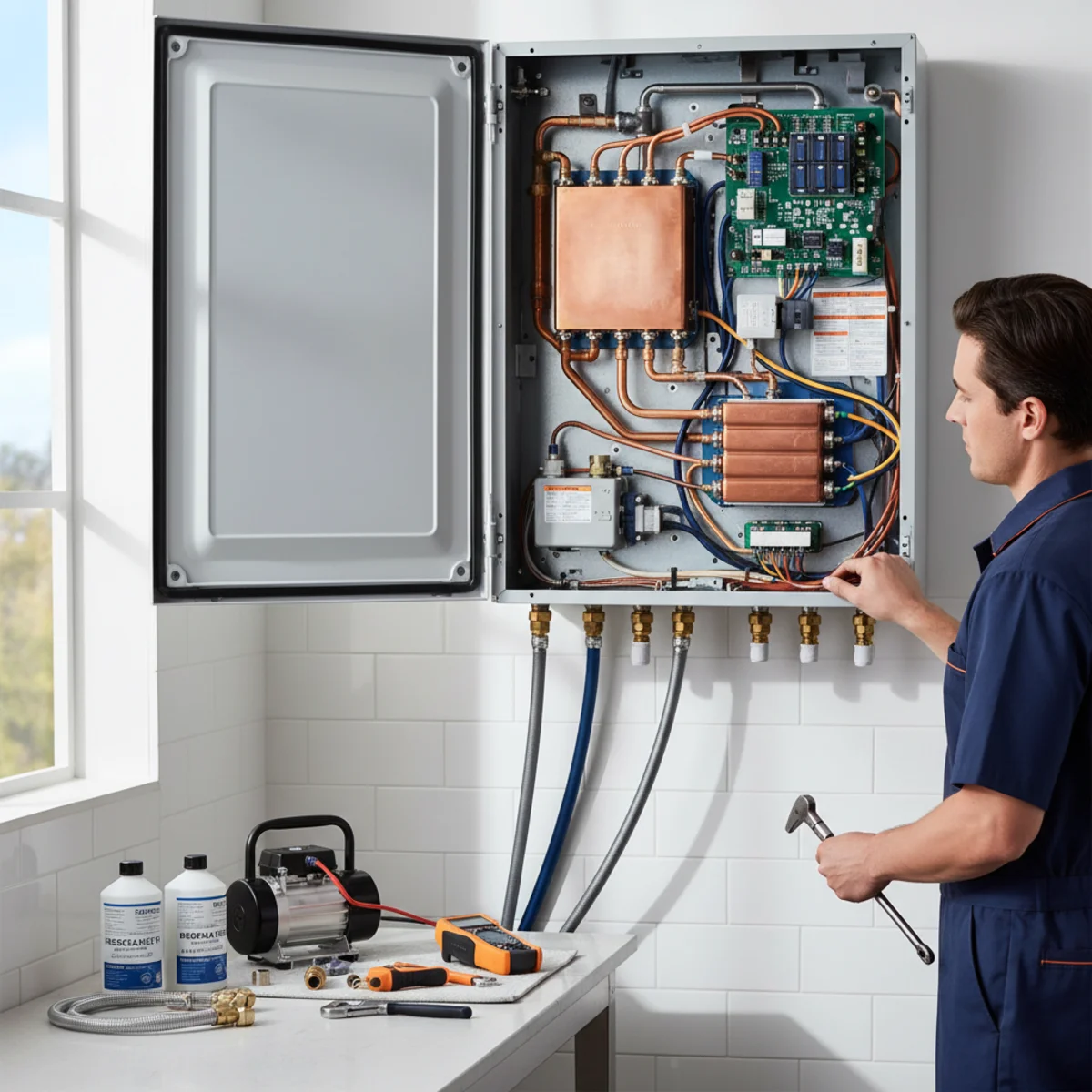
Inside a tankless water heater, cold water flows through a tight coil of tubing (the heat exchanger) that's surrounded by either gas burner flames or electric resistance coils. The water heats extremely quickly — in seconds — which means it's being pushed to high temperatures through a very small passage. That's where scale becomes a problem.
When hard water heats above about 140°F, dissolved calcium carbonate precipitates rapidly. In a tankless heat exchanger, this builds up on the interior walls of the tubing, narrowing the water passage and creating an insulating layer. The unit's control board detects that the water isn't reaching temperature and runs the burner harder and longer to compensate — increasing gas or electricity consumption while reducing flow rate.
Eventually the buildup gets thick enough to trigger error codes: most units will display a flow rate error (indicating restricted flow), an overheat error (indicating thermal stress from insufficient flow), or a heat exchanger temperature fault. At that point you're looking at a repair bill for descaling or, in severe cases, heat exchanger replacement — which on some units costs nearly as much as the unit itself.
Annual Descaling: What the Process Involves
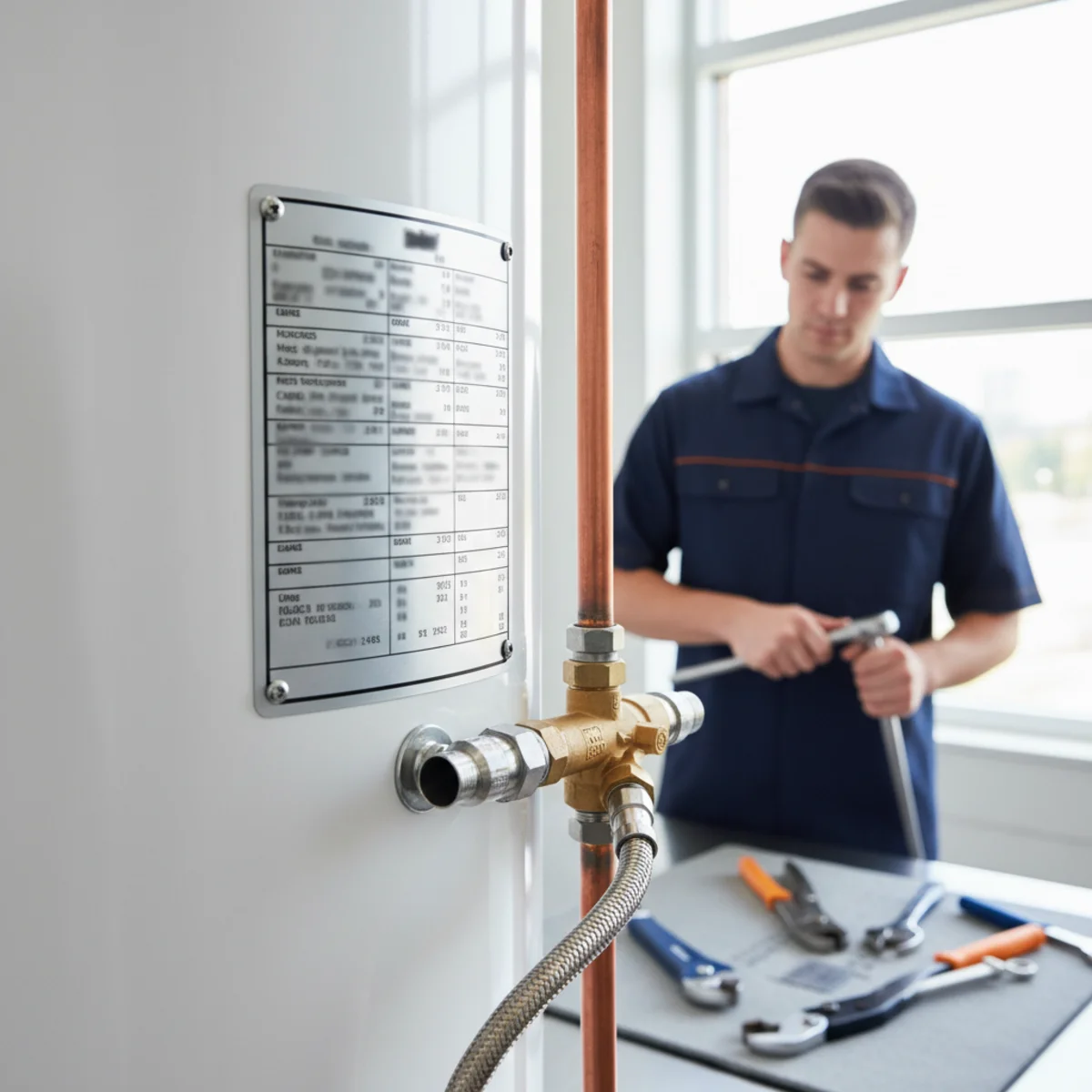
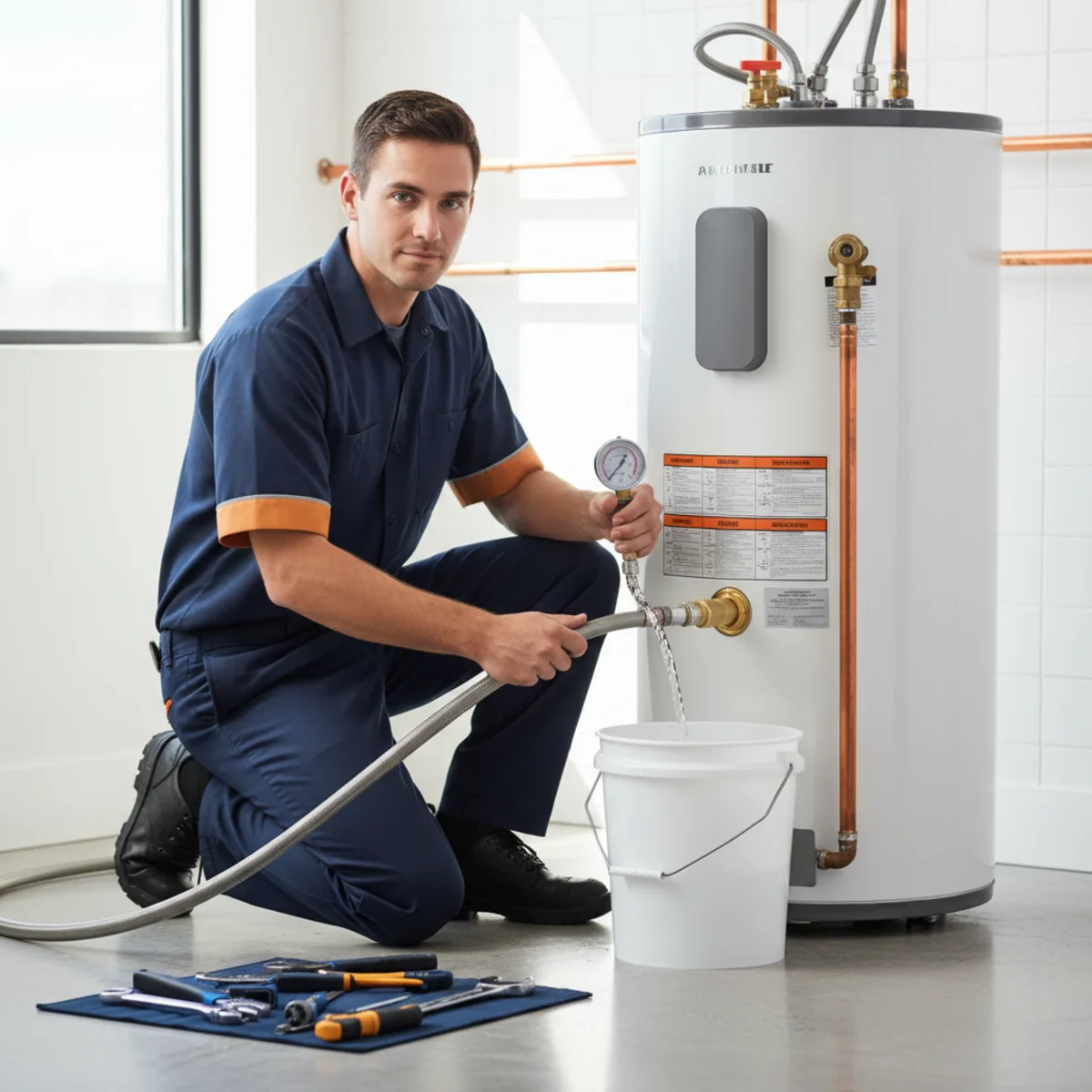
Descaling a tankless water heater involves circulating a mild acid solution — typically food-grade white vinegar or a commercial citric acid descaling solution — through the heat exchanger to dissolve mineral deposits. The process requires isolation valves (service valves) on the cold and hot connections, a submersible pump, and a small reservoir bucket.
If your unit was installed with service valves — which most professional installations include — the basic descaling can be done as a DIY task with a descaling kit. If service valves weren't installed, the technician needs to isolate the unit at the supply shutoff and connect bypass lines, which adds complexity.
The descaling cycle typically runs for 45–60 minutes. Afterward, the system is flushed with clean water to remove any remaining descaling solution. For units with heavy buildup, a second cycle may be needed.
- Shut off the gas or power supply to the unit before starting.
- Close the cold water supply and hot water outlet valves.
- Connect a submersible pump from the descaling bucket to the cold inlet service port.
- Run the hot outlet service port back into the bucket to create a closed loop.
- Circulate the descaling solution (white vinegar or citric acid) for 45–60 minutes.
- Flush the system with fresh water for 5–10 minutes before reopening to the plumbing.
- Inspect the inlet filter screen and clean if needed.
Inlet Filter Screen Cleaning
Most tankless water heaters have a small mesh screen filter on the cold water inlet connection. This screen catches debris — pipe scale, particles from the water main, small sediment — before it enters the heat exchanger. In a new home or after any plumbing work, the screen can clog quickly with flush-out debris.
Checking and cleaning this filter is a simple DIY task. Turn off the cold water supply, unscrew the inlet connection or filter housing, pull out the screen, rinse it under running water or brush it gently with a toothbrush, and reinstall. Do this as part of your annual descaling visit, or whenever you notice reduced flow or the unit struggling to maintain temperature.
Some units also have a hot water outlet filter. Check your specific model's documentation — not all models include one, but those that do benefit from the same cleaning interval.
Our tankless water heater repair team can handle descaling and filter service, or include it as part of a scheduled maintenance visit.
Venting Inspection for Gas Tankless Units
Gas tankless units are typically direct-vent or power-vent models that use PVC or CPVC piping to exhaust combustion gases outside. Unlike traditional atmospheric-vent tank heaters, these units push exhaust with a fan — which means blockages create a different failure mode: the unit detects insufficient combustion air or exhaust backpressure and shuts down.
Once a year, visually inspect the exterior vent termination. Wasp nests, bird nests, and accumulated debris are the most common blockages. The termination cap should be clear and the mesh screen (if present) should be clean. Inside the utility room, check that the PVC vent pipes are firmly seated and show no cracks, gaps, or discoloration from heat.
Also check the air intake — direct-vent units draw combustion air from outside through a second pipe. Verify the intake is unobstructed. A blocked intake on a direct-vent unit starves combustion and causes incomplete burning, which produces carbon monoxide. If you ever smell a sour or unusual odor near the unit during operation, shut it off and call a professional immediately.
Maintenance Schedule Summary
Here's a consolidated schedule for tankless water heater maintenance in Rancho Cordova's hard water environment.
| Task | Interval | DIY or Pro |
|---|---|---|
| Descale heat exchanger | Every 12 months (hard water) | DIY with service valves; Pro recommended |
| Clean inlet filter screen | Every 12 months or as needed | DIY |
| Inspect exterior vent termination | Every 12 months | DIY |
| Inspect vent pipe joints inside | Every 12 months | DIY visual; Pro if issues found |
| Check burner assembly and igniter | Every 12 months | Pro |
| Verify gas pressure | Every 12 months or if output drops | Pro only |
| Read error code history | Every 12 months | Pro |
| Full system pressure test | Every 3–5 years | Pro |
When to Call a Professional
Some maintenance tasks on tankless units go beyond what most homeowners should attempt. Checking gas pressure and manifold pressure — critical on gas units — requires a manometer and training. Inspecting the burner assembly, igniter, and flame sensor involves working inside the combustion chamber. Verifying the heat exchanger isn't cracked requires a pressure test.
Annual professional service covers all of this in addition to the DIY tasks above. A technician will also read the error code history stored in the unit's control board, which reveals patterns that a visual inspection misses — intermittent ignition failures, repeated flow errors, and similar issues that indicate components approaching failure.
For Rancho Cordova and surrounding communities, contact us to schedule a tankless maintenance visit. We'll descale the unit, clean the filters, inspect the venting and combustion system, and document any findings. See our water heater maintenance service page for what's included.
Homeowners in Rancho Cordova and the surrounding Sacramento area can reach us at (201) 277-9344. Annual maintenance costs a fraction of a heat exchanger replacement — and in hard water, it's what keeps the warranty valid.
Talk to a Local Rancho Cordova Water Heater Pro
Whether you need a repair today or you're planning an upgrade, we'll give you a straight answer and an upfront estimate.
Frequently Asked Questions
Common signs: reduced hot water flow rate, longer wait time for hot water, error codes on the display (particularly flow or temperature errors), or an increase in gas or electricity use without a change in usage patterns. In Rancho Cordova's hard water, annual descaling is the right preventive schedule regardless of symptoms.
Yes. Food-grade white vinegar (5% acidity) is effective for light to moderate scale and is safe for the heat exchanger material. Circulate it for at least 45–60 minutes. For heavy buildup, a commercial citric acid descaler may work faster. Avoid harsh mineral acids like muriatic acid — they can damage seals and heat exchanger alloys.
Yes. Electric tankless units have heating elements immersed in the water flow, and they scale just like a tank electric element — possibly faster because the temperature spikes are more intense. Annual descaling applies to electric tankless units in hard water areas just as much as to gas units.
The scale builds up to the point where it restricts flow and causes thermal stress on the heat exchanger. The unit runs inefficiently, triggers error codes, and eventually the heat exchanger can crack. Heat exchanger replacement is expensive — often $400–$800 in parts alone before labor. Annual descaling at a fraction of that cost is clearly the better path.
Most major tankless water heater manufacturers require documented annual maintenance in hard water conditions to keep the warranty valid. Keep a service record with dates and work performed. If you ever need a warranty claim, that documentation matters.
Written by the Water Heater RC Pros team
Practical, local guidance from Rancho Cordova water-heater installers — written for homeowners and kept current with California code. Have a question about your unit? Call (201) 277-9344.