Your water heater isn't producing hot water, and now you're standing in the garage trying to decide whether to fix it or replace it. The wrong call costs you either an expensive repair on a unit that fails again in six months, or a premature replacement you didn't need yet. Neither outcome is good.
The repair-or-replace decision comes down to four factors: the age of the unit, the nature of the failure, the cost of the repair relative to replacement, and what a new unit would actually do better. In Rancho Cordova, there's a fifth factor worth layering in: our hard water from the American River watershed accelerates sediment buildup and anode rod depletion, which shortens the practical life of tank water heaters compared to manufacturer specs written for softer water.
This guide gives you a clear framework with a decision table so you can walk into the conversation with your technician knowing what questions to ask and roughly where your situation lands.
The Age Rule — and Why It Isn't Absolute
The most-cited guideline is this: tank water heaters last 8–12 years; if yours is 10 or older and needs a significant repair, replacement is usually the smarter investment. That's a reasonable starting point, but it's not a rule you should apply blindly.
A 10-year-old unit in a soft-water area that's been regularly flushed and had its anode rod replaced may have years of life left. A 7-year-old unit in Rancho Cordova that's never been maintained and sits on hard well water can already have severe internal corrosion and compromised tank walls. Age is a proxy for condition — condition is what actually matters.
Check the serial number on the unit's data label. Most manufacturers encode the manufacture date in the first few characters. Once you know the actual age, pair it with the information below to make a better call.
Repair vs. Replace: Decision Table by Failure Type
Not all failures are equal. A failed heating element in a 4-year-old electric heater is a straightforward repair. A tank that's actively leaking from the bottom is almost never repairable. Here's how common failure types map to the repair-or-replace decision.
| Failure Type | Unit Under 7 Years | Unit 7–10 Years | Unit Over 10 Years |
|---|---|---|---|
| Pilot light or igniter failure | Repair | Repair | Evaluate — check overall condition |
| Thermostat or thermocouple failure | Repair | Repair | Lean replace if other issues present |
| Heating element failure (electric) | Repair | Repair | Repair or replace — your call |
| T&P valve failure (no tank corrosion) | Repair | Repair | Repair, but inspect tank condition |
| Anode rod depleted | Replace rod | Replace rod | Replace rod or full unit — inspect tank |
| Sediment buildup (no damage) | Flush + maintain | Flush + assess | Replace if efficiency is far down |
| Leaking from fittings or connections | Repair fittings | Repair fittings | Inspect before committing |
| Tank leaking from base or bottom | Replace immediately | Replace immediately | Replace immediately |
| Rust-colored water from hot side | Inspect anode and tank | Lean replace | Replace |
| No hot water — multiple causes unknown | Diagnose first | Diagnose first | Diagnose; likely replace |
The 50% Rule for Repair Costs
A practical rule used across the appliance industry: if the cost of the repair exceeds 50% of the cost of a comparable replacement unit, replacement is almost always the better financial decision. The logic is simple — you're spending half the price of a new unit on a part that doesn't come with the lifespan, efficiency, or warranty of new equipment.
Apply this with some nuance. If your unit is 4 years old and the repair is 45% of replacement cost, that repair probably still makes sense — you have 6–8 years of remaining life. If your unit is 9 years old and the repair is 40% of replacement cost, replacing is smarter because even a successful repair leaves you with aging equipment.
Our water heater repair team will give you an honest diagnosis and let you know when a repair doesn't pencil out. We'd rather tell you the truth than do a repair that fails in six months.
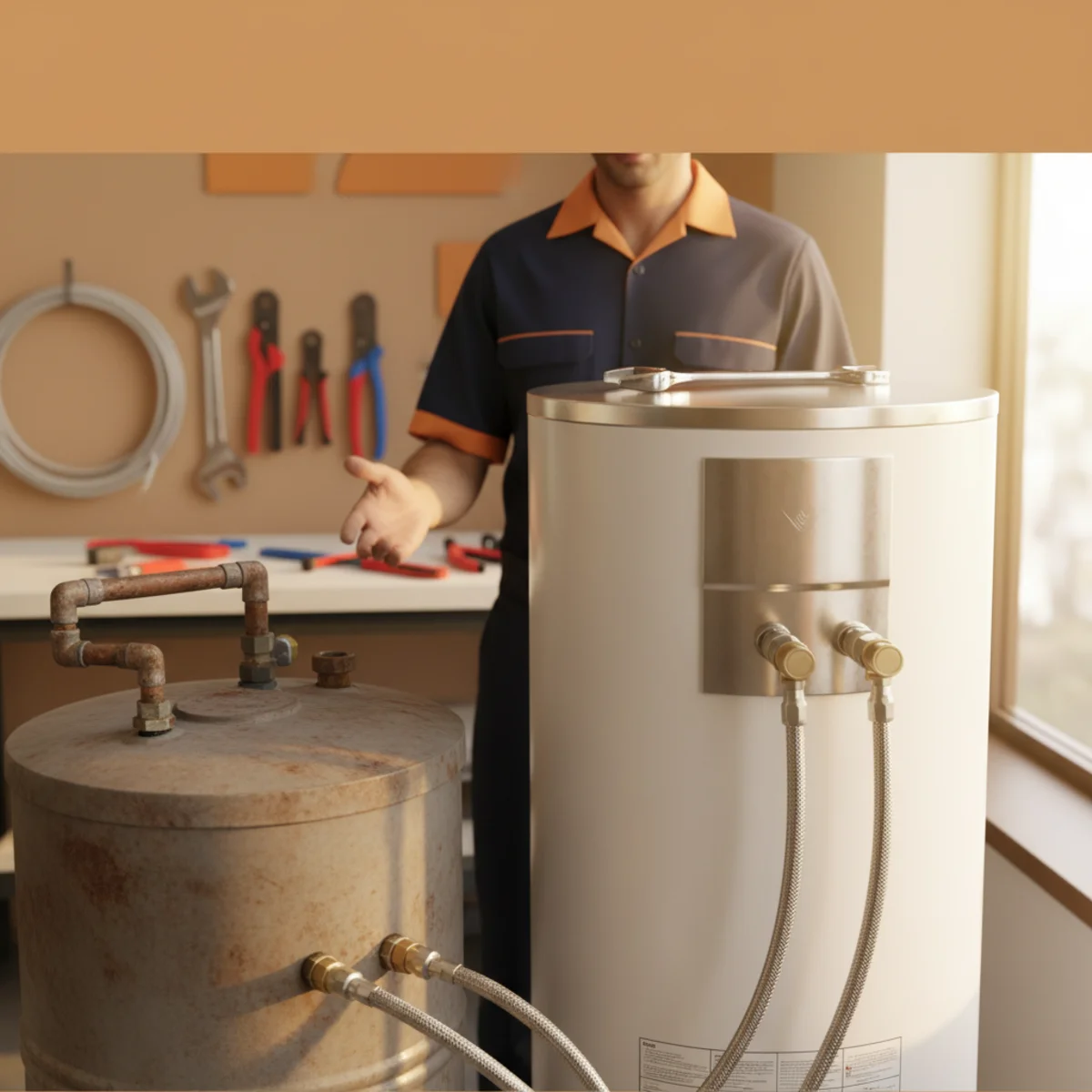
If replacement is the right call, water heater replacement covers the full process — including hauling the old unit and handling required California code upgrades like expansion tanks and seismic straps.
What a New Unit Actually Gets You
When replacement makes sense, it's worth understanding what you're actually getting beyond just hot water. Efficiency standards have tightened significantly. Units manufactured after April 2015 must meet higher Energy Factor (EF) or Uniform Energy Factor (UEF) ratings than older models. A 12-year-old tank unit likely has a UEF in the 0.55–0.60 range. Current standard units come in around 0.62–0.67. Heat pump water heaters, which qualify for SMUD and PG&E rebates (confirm current program details before you buy), can reach UEF values above 3.0.
California also requires several code upgrades at the time of water heater replacement: a thermal expansion tank if you're on a closed plumbing system, double-strap seismic restraint, a proper drain pan, and updated T&P valve discharge piping to a safe termination point. These aren't optional and they add to the total project cost — but they make your installation compliant and safer.
If you're in the Rancho Cordova area and weighing your options, we're happy to give a straight assessment. You can also reach us directly at our contact page.
Signs That Make the Decision Easy
Some situations don't require a table or a formula — they point clearly toward one answer.
- Active leak from the tank base — replace, no exceptions. A leaking tank cannot be reliably repaired and the water damage risk is immediate.
- Unit is over 12 years old and has never been serviced — replace. The internal components are well past their expected service life in our hard-water environment.
- Rust-colored hot water that persists after flushing — the tank is corroding internally. Replace before it fails catastrophically.
- Repair cost quoted is more than half the price of a new unit — replace and get a warranty.
- Pilot light failure on a unit under 5 years old — repair. This is a minor component, not a tank issue.
- You're remodeling or adding square footage — replace proactively and right-size for the new demand.
Talk to a Local Rancho Cordova Water Heater Pro
Whether you need a repair today or you're planning an upgrade, we'll give you a straight answer and an upfront estimate.
Frequently Asked Questions
Look at the data label on the side of the unit — usually near the top. The serial number typically encodes the manufacture date. The first letter often represents the month (A=January, B=February, etc.) and the next two digits represent the year, but this varies by brand. If you're not sure, call us with the brand and serial number and we can decode it.
Rarely, but yes — if it has a manufacturing defect that causes repeated failures, if it was severely undersized for your household, or if you're switching fuel types (gas to electric or vice versa) for energy or rebate reasons. In most cases, a 6-year-old unit failing is a repair situation, not replacement.
Not necessarily. The T&P (temperature and pressure relief) valve is a standalone safety component and can be replaced independently. However, if it's releasing because the water is actually overheating or the pressure is genuinely too high, that underlying issue needs to be diagnosed and fixed — a failed valve can mask a more serious problem.
SMUD and PG&E have offered rebates for high-efficiency and heat pump water heaters in the past, and California sometimes has state-level programs as well. Rebate programs change frequently — confirm current availability and requirements before purchasing. Your installer can often tell you what's currently active.
California requires thermal expansion tank (on closed systems), seismic double-strap restraint, a drain pan with discharge piping, and proper T&P valve discharge termination at time of replacement. These are not optional — they're required for permit sign-off and for homeowner's insurance compliance in many cases.
Written by the Water Heater RC Pros team
Practical, local guidance from Rancho Cordova water-heater installers — written for homeowners and kept current with California code. Have a question about your unit? Call (201) 277-9344.